

This year’s mild winter has induced the Holly trees to flower early. The tiny flowers appeared a few weeks earlier than normal for the past two weeks. The evergreen privacy fence of Holly trees drops some of their leaves in the spring, and its flower production, if pollinated by the bees, produces the berries. At first, they are tiny green beads, but as they grow through the season, they eventually turn red in the fall.
Many times, the birds get the berries first before we see them. Jumping around the Holly branches, the birds grip with their feet, which can easily break and knock off the new tiny green berries. When we see the clumps of red berries in the fall, they create a marvelous living fence.

Picture of tiny Nellie Stevens Holly flower and the first state of the berries.
Nellie Stevens Holly Pollination
At Pryor’s Nursery, we have 2 male blue prince hollies that can pollinate 4 acres of Nellie Stevens Holly. If a male is within a quarter mile, your Hollies may receive pollination from the busy little bees. This is another reason why we must keep the bee population from being endangered. However, pollination isn’t always necessary for the Nellie Stevens Holly hybrid, but pollination does produce more bright red berries.
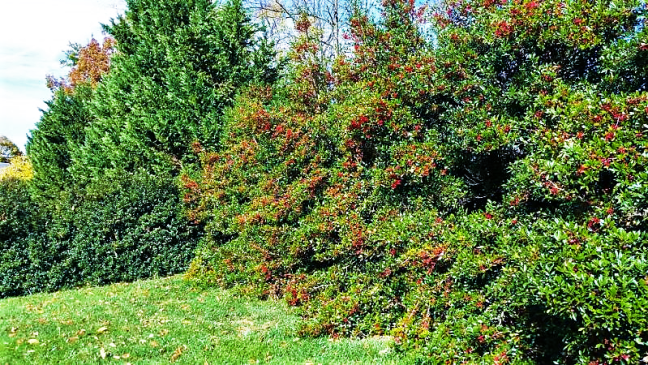
The above picture is of a living fence made of Nellie Stevens hollies with bright red berries. They are a wonderful, visually appealing change with the seasons. Hollies are a great addition to any landscape project, whether as a stand-alone statement species tree or as a privacy screening. During December, trimmings from the holly trees can also be used for holiday decorations.
We at Pryor’s Nursery have been locally growing and planting quality Nellie Stevens Holly trees for over 40 years. We have expertly helped our customers solve their privacy screening issues. If you are located in Maryland, DC, northern Virginia or northern West Virginia, we can help!
